
You know that feeling when the sky goes dark at 4pm, the first drops start hitting the leaves, and you are still fumbling with poles? We have all been there. Malaysian weather does not negotiate. It rains when it wants, the humidity sits at 80% even on a clear morning, and any gear that was not built for these conditions will remind you of that fact pretty quickly. So when people started asking us how the TAHAN Pavillion stacks up against Coody's inflatable tents, we figured it was worth sitting down and being honest about it.
Full disclosure: TAHAN is our gear. We will tell you exactly where Coody beats us, because that is the only way the rest is worth believing. Both brands are sold in Malaysia, both are trying to solve the same problem (a shelter that does not turn into a sauna or a swimming pool), and they take very different approaches to get there. Let us get into it.
What Coody Gets Right
Coody has built something genuinely interesting. Their inflatable tent concept, using pressurised PVC air beams instead of metal or fiberglass poles, solves a real problem that Malaysian campers face: pole corrosion. If you have ever pulled a traditional dome tent out of storage after a few humid months and found the aluminium poles developing micro-fractures or the ferrules sticking together, you understand exactly why no-pole shelters are appealing here. With Coody, there is nothing metal in the frame to rust or snap.
The TC fabric (210 gsm, 65% polyester and 35% cotton) they use across the 8.0, 13.6, and 17.2 models breathes genuinely well. Condensation is a real enemy in tropical camping, and cotton-blend canvas manages it better than straight polyester in most conditions. Malaysian campers who have used the Coody 8.0 and 13.6 report staying noticeably drier inside compared to budget nylon tents, which is a legitimate win.
The YKK zippers with silicone-based anti-corrosion coating are a thoughtful detail for coastal camping. Anyone who has camped at Perhentian or Tioman and watched cheap zippers seize up from salt spray will appreciate this. Setup speed on the inflatable models is also genuinely fast once you have done it a couple of times: the Coody 8.0 inflates in roughly 10 minutes with the included pump. And for the larger 13.6 model, the optional Air Tarp vestibule gives you serious covered living space that zips on without any complicated rigging.
The 17.2 is a beast of a glamping shelter at 17.2 m² and rated for 10 people, with a PU3000+ rainfly and large TPU windows that give you natural light without opening to the rain. If you are doing a proper group camp or a family basecamp where the tent goes in the back of an MPV and does not move for three days, Coody gives you a lot of covered square footage.
Head to Head
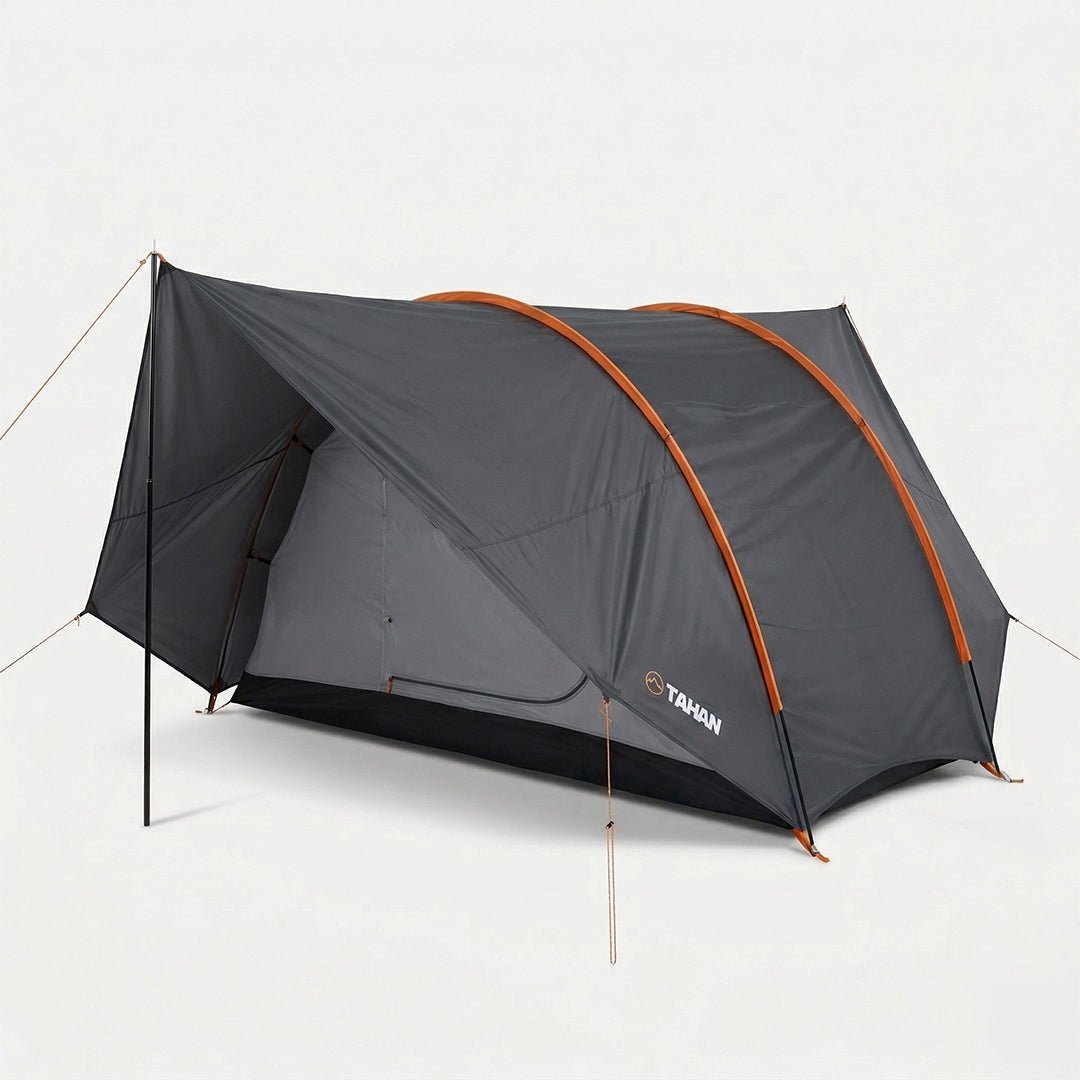
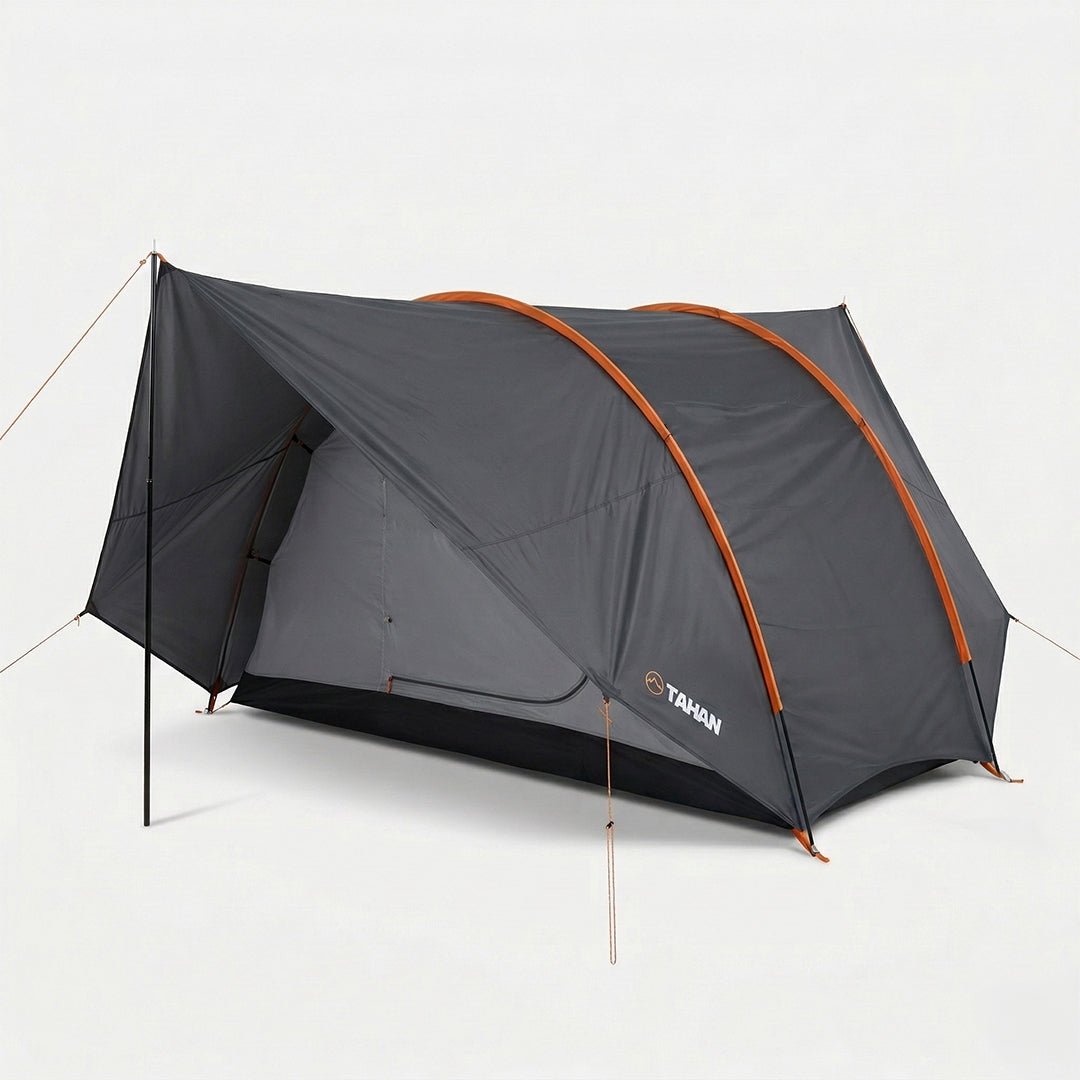
TAHAN Pavillion Family Tent vs Coody 8.0 Air Tent
| Spec | TAHAN Pavillion | Coody 8.0 |
|---|---|---|
| Floor area (shelter/total) | Shelter seats 6; cabin 330 x 142 cm | 8.0 m² internal (3.2 x 2.5 m) |
| Standing height | 2.0 m (shelter), 1.75 m (cabin) | 2.2 m (ceiling 2.04 m) |
| Weight | 10.3 kg | 35 kg net (approx. 28 kg tent-only) |
| Packed size | 59 x 26 x 19 cm | Check current listing |
| Frame / structure | Steel + fiberglass poles | 6 TPU-coated PVC air beams (0.7 mm) |
| Fabric (body/shelter) | 210D Oxford PU3000, sealed seams | TC canvas 210 gsm (65% poly / 35% cotton) |
| Rainfly / fly rating | Shelter IS the outer layer, PU3000 | PU3000+ tarp/flysheet |
| Sleeping cabin | Full B3 mesh inner cabin included | Open layout, no separate inner |
| Capacity | 2 adults + 2 kids sleeping; 6 seated in shade | 1 to 4 people |
| Setup time | 15 min (2 persons), 20 min (solo) | Approx. 10 min with pump |
| Price (at time of writing) | RM999 | Approx. RM3,000 (check current listing) |
| Warranty | 1-year on manufacturing defects | Check current listing |
The Coody 8.0 is taller and you get an open inflatable volume of 8 m². But at 35 kg net weight, it is a two-person carry minimum just to move it from the car to the campsite. The TAHAN Pavillion at 10.3 kg packs into a bag that fits in a Myvi boot alongside your cooler. If your campsite involves any walking, that weight difference matters a lot. The Coody's strength is the no-pole setup and the all-cotton-blend breathability; the Pavillion's strength is that one person can actually manage it solo in about 20 minutes.
TAHAN Pavillion vs Coody 13.6 (Larger Group)
| Spec | TAHAN Pavillion | Coody 13.6 |
|---|---|---|
| Floor area | Shelter + cabin combo | 13.6 m² (3.6 x 3.8 m) |
| Weight | 10.3 kg | 60 kg net |
| Fabric | 210D Oxford PU3000 | 210 gsm TC canvas, PVC floor (non-removable) |
| Rainfly rating | PU3000 (shelter layer) | 420D Oxford PU3000 |
| Windows / ventilation | Open ends + B3 mesh cabin | 6 windows, 4 TPU, 2 doors, stove jack |
| Capacity | Family of 4 sleeping; 6 in shade | 2 to 8 sleeping |
| Price (at time of writing) | RM999 | Approx. RM5,295 (check current listing) |
The 13.6 is where Coody really shines for group use. You get genuine room to stand and move around, a stove jack for cool-weather cooking, and six windows that you can switch between mesh and TPU panels depending on conditions. The Pavillion cannot match that square footage. But the 13.6 weighs 60 kg net. Getting it to any campsite that is not right next to a car park is a real logistics exercise. For a family weekend at a campsite with proper access, the 13.6 is genuinely impressive. For anything that requires more than a trolley push from your boot, the Pavillion is the practical answer.
Where TAHAN Wins, and Why We Built It That Way


When we designed the Pavillion, the first question was not "how big can we make it" but "how does a Malaysian family actually get to their campsite and what happens when it rains at 2am." Those two questions drove most of the decisions.
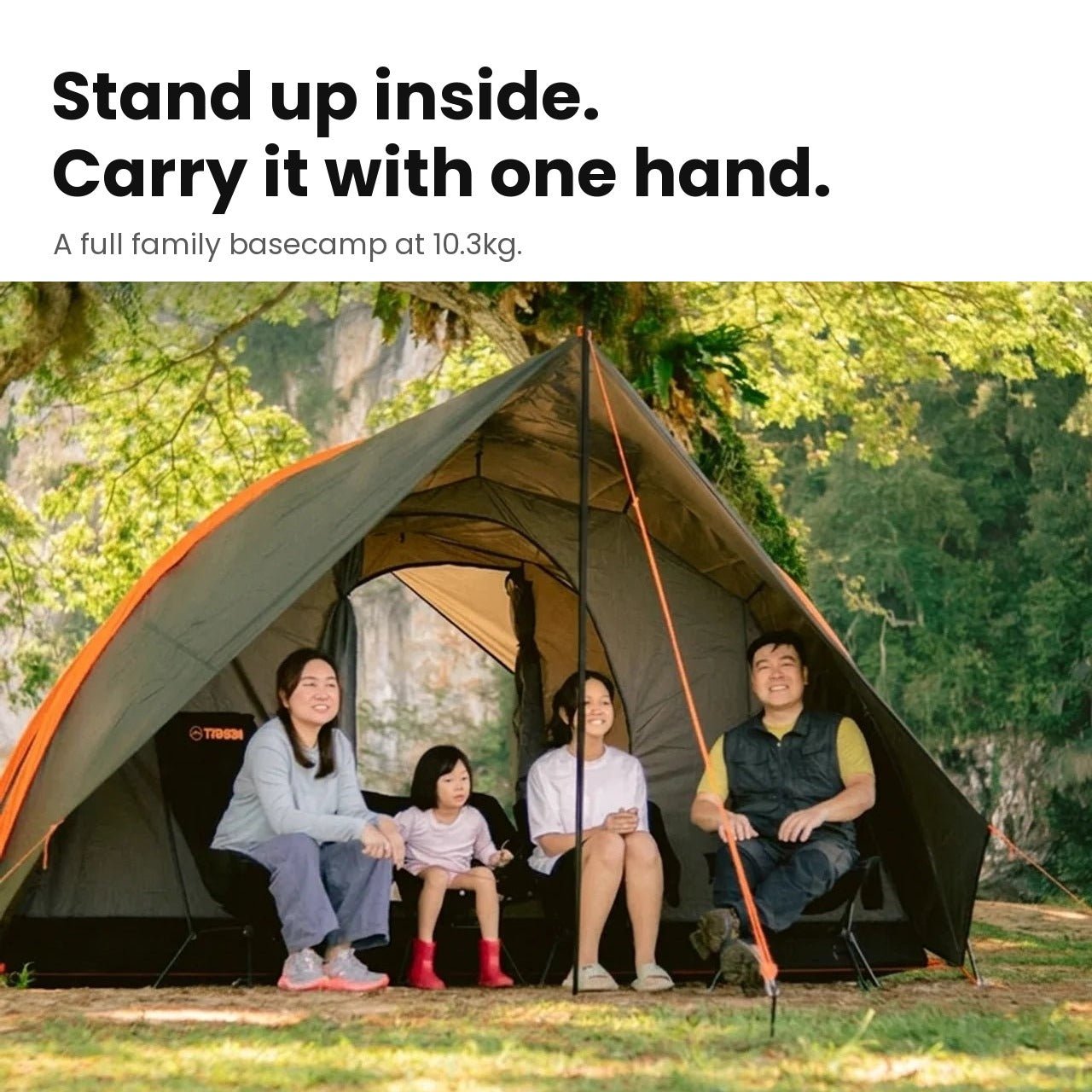
Weight and packed size come first. At 10.3 kg and packed to 59 x 26 x 19 cm, the Pavillion fits in the boot of a Myvi, an Axia, or a City alongside all your other gear. That is a deliberate choice. You still get 2m of standing height under the shelter. Every TAHAN product goes through 3 to 5 sample rounds minimum before release. Most global shelters at this capacity are designed for people driving pickups or 4WDs. We started from a Perodua boot.
The open-ended shelter design is a tropical decision. We kept both ends of the shelter openable because Malaysian heat does not stop just because it is raining. A fully enclosed tent turns into a greenhouse by 9am. The Pavillion lets air move through from front to back, so you can cook under the front canopy, have the kids in the back shade, and still get a cross-breeze. The PU3000 210D Oxford fabric with sealed seams handles the rain while the airflow handles the heat. That combination is not common in shelters at this price point.
The B3 mesh sleeping cabin is a separate layer for a reason. In humidity, a single-skin sleeping space with no mesh is a condensation trap. The full mesh cabin keeps insects out while letting every bit of available airflow through. When it cools down, the cabin walls zip closed. This dual-layer approach (waterproof outer shelter, breathable mesh inner) is the same principle used in high-end backpacking tents, scaled up to family size. And because the cabin is a separate clip-in unit, you can leave it at home entirely and use the Pavillion as a pure shade structure for six people.
Durability in Malaysian conditions means thinking about what breaks first. We use a steel and fiberglass frame combination because fiberglass flexes rather than snapping under sudden load, and the steel uprights give you the rigid standing height. The sealed seams on the PU3000 fabric are the difference between "water resistant" and "stays dry at 2am in a heavy downpour." The Pavillion is tested in real Malaysian downpours, and it holds 4.86 stars from 1,051 reviews.
At RM999, the Pavillion is designed to last you years, not seasons. The fabric is not a thin nylon that pills and delaminate after six months of tropical UV. We see it as a long-term buy, which is why we back it with a 1-year warranty on manufacturing defects. Check out our Family Camping Tents in Malaysia guide for more context on what to look for in a shelter built for our climate.
The TAHAN Pavillion Family Tent currently sits at 4.86 stars from 1,051 reviews. That is not a launch number; that is sustained feedback from people who have actually used it in the field.
Who Should Buy Which
Buy the TAHAN Pavillion if:
- You are a family of four and need a shelter plus sleeping space in one package under RM1,000.
- Your car is a Myvi, Axia, City, or any standard sedan or hatch. The packed size was designed with Malaysian car boots in mind.
- You camp at a mix of sites, some with easy car access and some where you need to walk a bit. At 10.3 kg, one person can manage it.
- You want to be set up in 15 minutes and have the option to use the shelter without the inner cabin as a shaded hangout for six people.
- You want to know the gear will still be in good shape after two years of monthly camping, not just one season.
Buy a Coody tent if:
- You do glamping-style basecamp trips where the tent goes in by car and does not move. The 13.6 and 17.2 give you genuine room to live in, not just sleep in.
- You genuinely hate dealing with poles and have a vehicle that can handle 35 to 60 kg of packed gear without issue.
- You want a stove jack for cool-weather highland cooking (the Coody 13.6 has one; the Pavillion does not).
- Group sizes of 6 to 10 sleeping adults are your regular scenario, especially for extended stays.
- You camp near the coast frequently and want the YKK silicone-coated zippers for salt resistance.
- Budget is less of a concern and you want maximum square footage in a single shelter.
Honestly, these two brands are not really competing for the same camper. Coody is building glamping infrastructure. TAHAN is building gear for the family that camps once or twice a month, packs the car on Friday night, and needs everything to work reliably without a logistics team. Both are valid. Know which one you are before you spend.
If you are still figuring out what kind of camping setup fits your family, our Khemah Camping Malaysia guide breaks down the different shelter styles and what works for different trip types in Malaysia.
FAQ
Is the Coody tent genuinely waterproof for Malaysian rain, or do I need to season it first?
The TC canvas on Coody tents needs a seasoning process where you wet and dry the fabric a few cycles so the cotton fibres swell and seal the stitch holes. After seasoning, Coody reports a hydrostatic head of around 2000 mm on the tent body (the rainfly on the 13.6 and 17.2 is rated PU3000). Malaysian afternoon downpours are heavy and sustained, so the seasoning step is not optional. The Coody 8.0's specific body waterproof rating is not listed in their published specs; check their current listing before buying. The TAHAN Pavillion's 210D Oxford fabric is PU3000 with sealed seams and does not require pre-treatment.
Can I set up the TAHAN Pavillion alone, or do I really need two people?
You can set it up solo in about 20 minutes. The shell unfolds, two rods slide in, steel poles stand it up, you peg it down, then clip in the inner cabin. It is a logical sequence. Two people gets you to 15 minutes and makes the initial frame stand-up easier, but solo is genuinely doable. The Coody inflatables technically inflate solo too, but moving a 35 kg or 60 kg packed bag from the car to the site is realistically a two-person job.
How does the TAHAN Pavillion compare to Coody for ventilation in Malaysian heat?
The Pavillion uses a fully open-ended design so air moves through from front to back even when the rain cover is on. The B3 mesh inner cabin lets airflow through while keeping insects out. The Coody tents use switchable mesh and TPU panel windows on the sides, which works well but relies on window management. In practice, both handle ventilation better than a sealed dome tent. The Coody canvas fabric arguably manages condensation better due to the cotton content; the Pavillion's open-end airflow means condensation rarely builds up inside the cabin in the first place.
Where can I buy Coody tents in Malaysia, and are the prices consistent?
Coody has an official store in Seri Kembangan, Selangor, and is contactable via Instagram at @coodymalaysia. They are also listed on Lazada and Shopee. Pricing varies quite a bit: AliExpress listings show RM320 to RM410 for some models, while used listings on Carousell show the Coody 8.0 at around RM3,000 and the 13.6 at around RM5,295 retail. The official website prices at time of writing show RM5,295 to RM8,885 depending on model, but the site has been noted as under construction. Always verify pricing and stock directly with Coody Malaysia before purchasing.
More gear guides:
Mike has been camping across Malaysia for over 10 years, from jungle treks in Taman Negara to beach camps in Perhentian. He co-founded TAHAN to build gear for tropical reality. Follow the TAHAN blog for honest campsite reviews, every week.