

Exploring Candi Borobudur - A Backpackers Guide
Here's a few interesting fact to start off with. Did you know that Candi Borobudur is the world's LARGEST Buddhist Temple? Also, did you know that there was a civilization there previously which in a way mysteriously disappeared from Candi Borobudur? Did you also know that the temple actually dates back to the 9th century, which is older than Angkor Wat itself? If you find all these interesting, read on!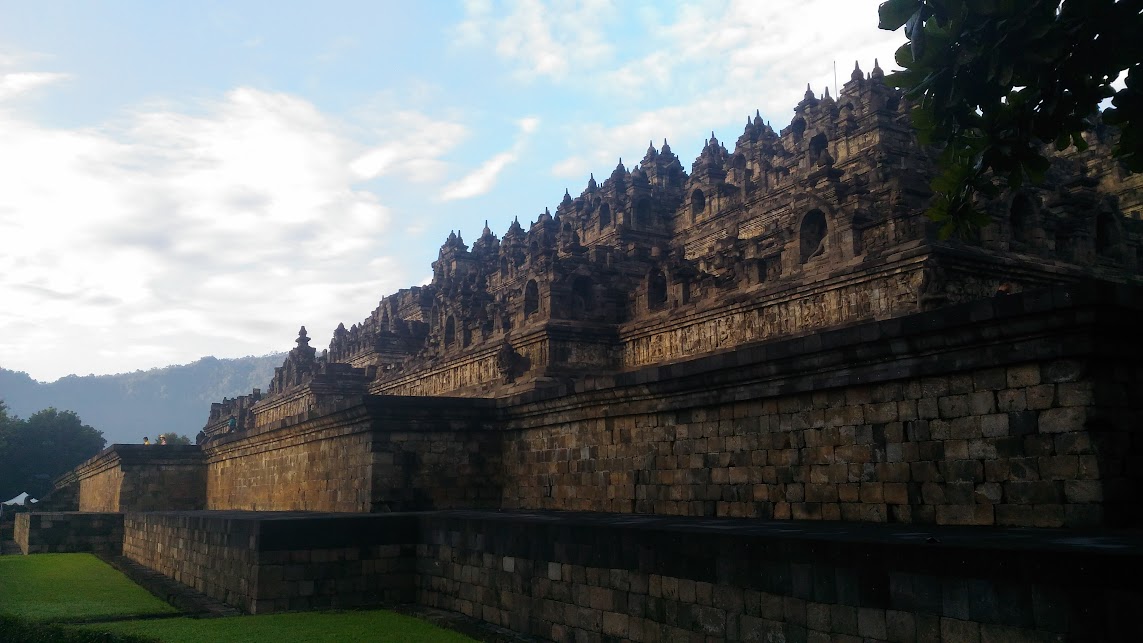 Candi Borobudur in the morning
Getting There
Candi Borobudur opens at 7:00 AM and closes at 5:00 PM. It’s better to get there as early as you can because the weather is cooler, you avoid the rush of tourists, and pictures are better with morning sunlight. By Bus: The buses to Candi Borobudur leaves from the Jombor bus terminal. You can reach Jombor station via the Trans-Jogja bus. The Trans-Jogja busses 2B and 2A (Rp 3,600) runs from central Yogyakarta to Jombor bus terminal in northern Yogyakarta, where you can change to another bus to get to Borobudur Bus Terminal. The Trans-Jogja staff and Jombor station staff are very friendly and will direct you to the correct buses. Bus takes about 60-90 minutes, and will cost Rp 25,000 one way (pay on the bus). There will be a short break at Muntilan Bus Terminal for about 15 minutes. Make sure you don't get off here. Upon arrival at Borobudur Bus Terminal, walk 5 minutes to the south and reach the big parking lot of Borobudur Temple. By Bike: I personally took the bike which was arrange by the team at Wake Up Homestay (thanks guys!) and that took me around 90 minutes to reach Candi Borobodur. It was of course the easier way and a more riskier one but if you got a professional driver like mine, you're in good hands. Besides, taking the bike gives you the most picturesque scenery of the village route. Pictures as per below: Quick way to Candi Borobudur? Take a bike!Entrance Fee
The entrance fee stated below is of March 2016 and it includes the rates for Prambanan Temples as well. There are people who would love to pack Prambanan, Ratu Boko and Candi Borobudur into a full day trip but I did otherwise. Either way is fine as long as it goes according to your speed and schedule. Read my guide on Prambanan here: Prambanan Temple - A Yogyakarta Traveler Guide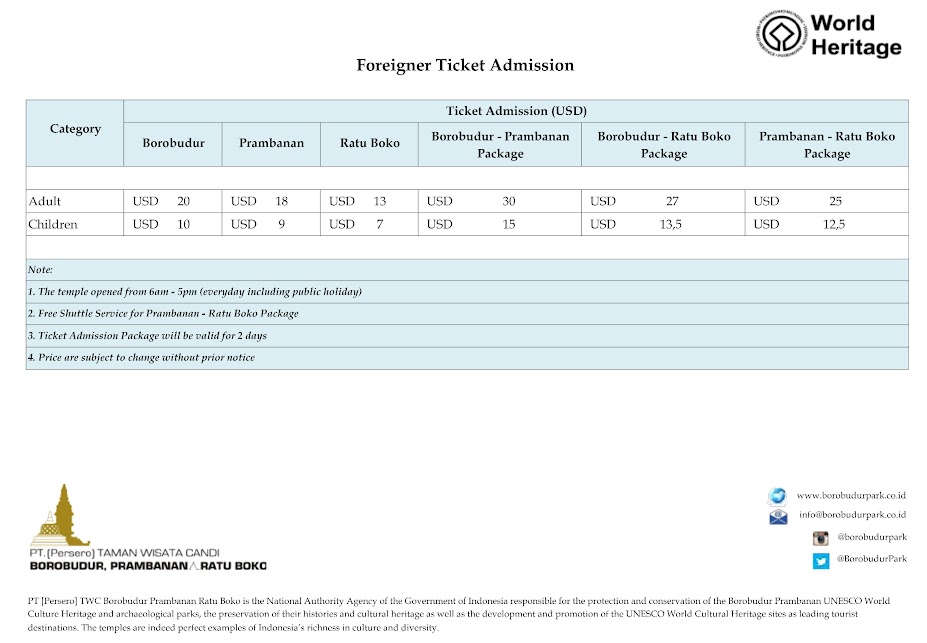 Rates for Candi Borobudur and other temples as well - click to enlarge
Exploring Candi Borobudur
So, now you're in Candi Borobudur. The majestic view of the temple stands in front of you. There are a few stories of the temple and you have no idea what to do. Lucky you, you are reading this guide. According to my trusted guide, to achieve Nirvana, you are to walk clockwise around the temple, one terrace at a time. There are a total of 9 platform (terrace) on Candi Borobudur, 6 of them square the the top 3 being round. Cross section of Candi Borobudur I, being a believer, of course followed the clockwise walking motion on each terrace as per mentioned and finally reached the top of Candi Borobudur. Apparently I later found out that the top of the temple is what devotee's would call the Nirvana layer, which is the highest level any Buddhist would aim to go. I guess that's as close as reaching Nirvana as I can get for now.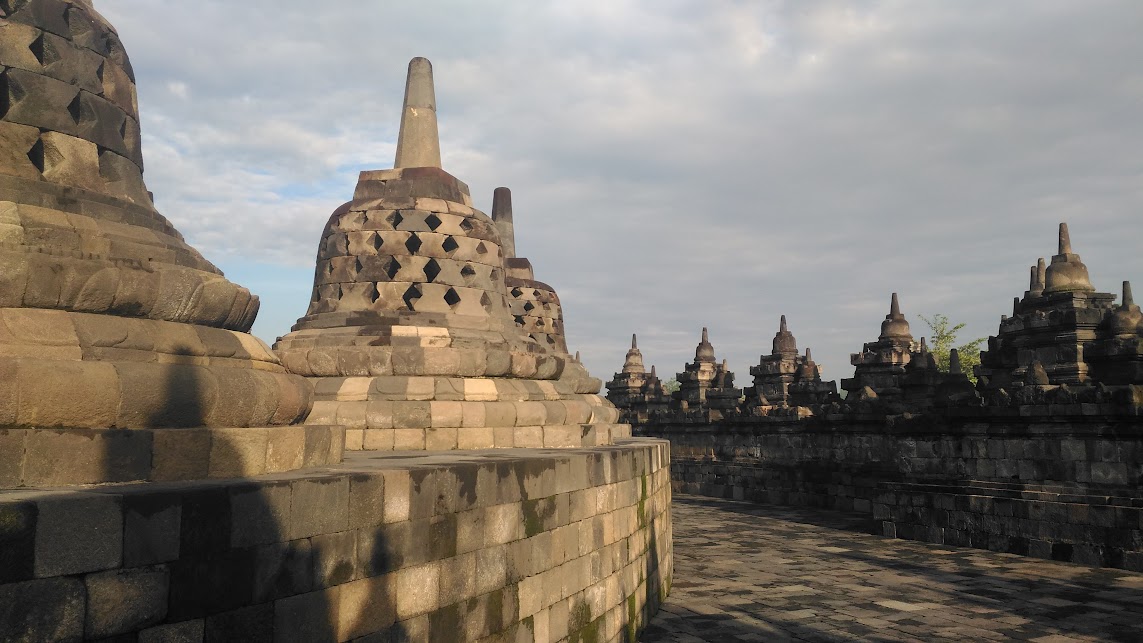 Top circular layer with Stupas lining it
At the picture seen above is perforated stupas that lines the top of the Candi Borobudur. If you peek inside the stupa, you will notice that there are Buddha statues in there, some with their hands cracked off. Confused, I asked my guide on the weird happening and he explained that people believed that if you manage to reach in the holes and touch the hand of the Buddha, your wish will come true. *tempting*
Yes, just in case you are wondering, I tried reaching in as well like any typical tourist would but my short hands failed me and I did not get my wish granted.
A headless statue of Buddha sitting in one of the Stupa in Candi Borobudur
Along the terraces of the Candi Borobudur lines beautiful carvings like the ones that you will witness on the walls of Prambanan Temples. You will also notice that a lot of the carvings looks very similar at both the sites.
Top circular layer with Stupas lining it
At the picture seen above is perforated stupas that lines the top of the Candi Borobudur. If you peek inside the stupa, you will notice that there are Buddha statues in there, some with their hands cracked off. Confused, I asked my guide on the weird happening and he explained that people believed that if you manage to reach in the holes and touch the hand of the Buddha, your wish will come true. *tempting*
Yes, just in case you are wondering, I tried reaching in as well like any typical tourist would but my short hands failed me and I did not get my wish granted.
A headless statue of Buddha sitting in one of the Stupa in Candi Borobudur
Along the terraces of the Candi Borobudur lines beautiful carvings like the ones that you will witness on the walls of Prambanan Temples. You will also notice that a lot of the carvings looks very similar at both the sites.
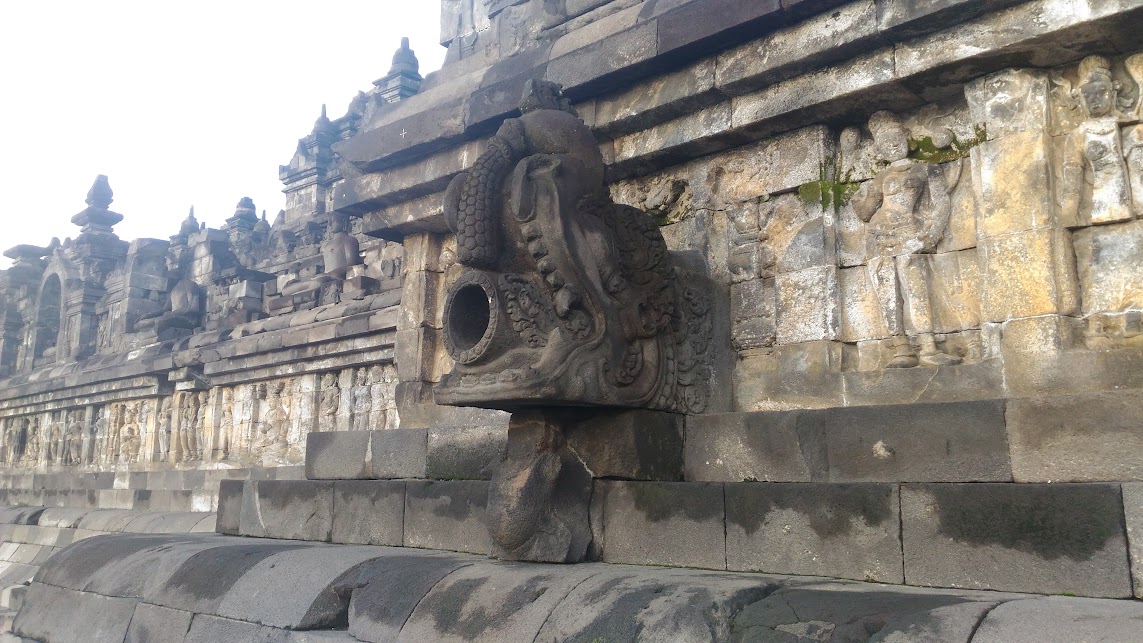 Water flows our from holes like these on rainy days
The Wall Reliefs Of Candi Borobudur
You can think of Borobudur as a very large teaching graphic recounting the life story of the Buddha, his teachings and his progress towards Nirvana. If you want to truly understand the reliefs, it is best to employ a guide to explain the stories to you.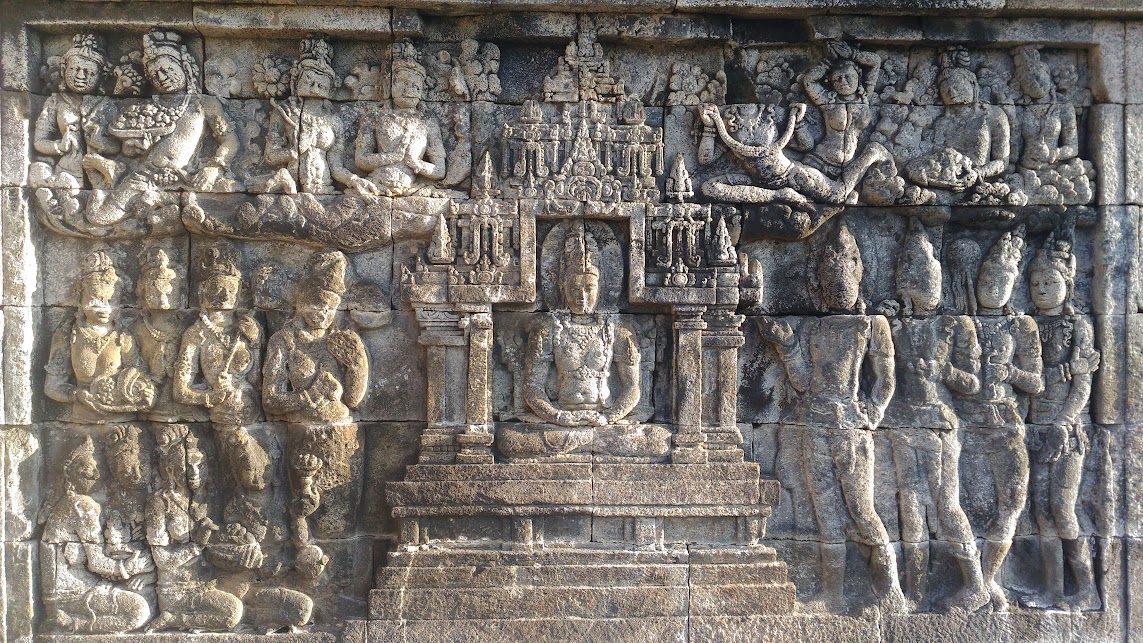 Wall Relief on the walls of Candi Borobudur
In short, the 2,760 reliefs tell four key sets of stories in the form of carved illustrations and Sanskrit inscriptions:
Wall Relief on the walls of Candi Borobudur
In short, the 2,760 reliefs tell four key sets of stories in the form of carved illustrations and Sanskrit inscriptions:
- The law of karma or Karmavibhangga. These are mostly hidden by the post-original construction masking at the foot of the monument. The reliefs tell stories and give examples of the nature of karma with depictions of both praiseworthy (including co-operative working practices and planned parenthood) and blameworthy (including torture, rape and theft) activities. The masking was disassembled in 1890 before being painstakingly rebuilt, and photographs were taken of the reliefs at this time. These photographs are displayed in the Borobudur Museum.
- The birth of Buddha or Lalitavistara. Before the story starts, there are 27 panels showing preparations for the final earthly incarnation. The story then begins with the descent of the Lord Buddha from heaven, and continues until his first earthly sermon as Prince Siddhartha.
- The Jatakas and avadanas. Jatakas are stories about the Buddha before he was born as Prince Siddhartha. Avadanas are similar to jatakas, but the main figure is not Buddha himself. Both are depicted in the same series of reliefs.
- The journeys of Sudhana searching for ultimate truth or Gandavyuha. This is the story told in the final chapter of the Avatamsaka Sutra about Sudhana's tireless wandering in search of the highest perfect wisdom.
Facts about Candi Borobudur
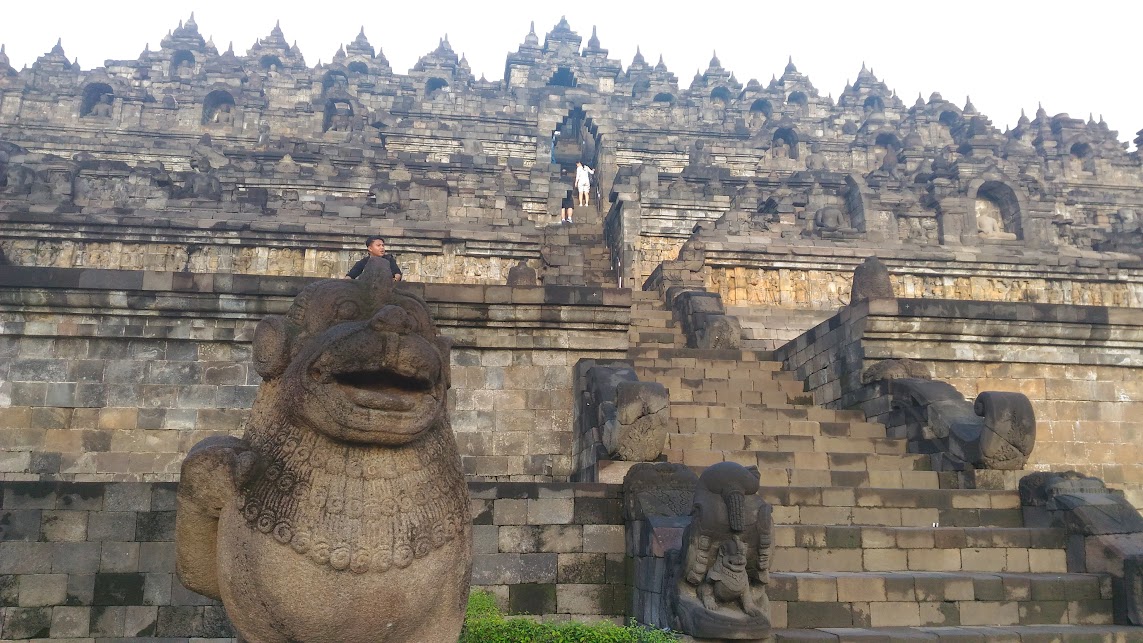 This is where you take your first step to Nirvana
Here's a few of Candi Borobudur's fact that you might find handy if you are not planning to hire a guide:
This is where you take your first step to Nirvana
Here's a few of Candi Borobudur's fact that you might find handy if you are not planning to hire a guide:
- Candi Borobudur is a Buddhist stupa and temple complex in Central Java, Indonesia dating from the 9th century, and a certified UNESCO World Heritage Site.
- It is estimated that the construction of Candi Borobudur took around 75 years to complete.
- Candi Borobudur was abandoned and hidden for centuries under layers of volcanic ash and thick jungle growth. Nobody knows for sure why it was abandoned, although the popular theories are that the local population just became uninterested when there were mass conversions to Islam in the 15th century, or they were simply driven away by a large volcanic eruption.
- Candi Borobudur was heavily affected by the eruption of Mount Merapi in October and November 2010. Volcanic ash from Merapi fell on the temple complex, which is approximately 28 km away from the crater, killing the vegetation around it as well.
- There are some who believe that the inside of Candi Borobudur lies the secret of ancient Buddhism practice. (unproven)
🏕️Join the TAHAN Camping Community
Campsite intel, weekend spot ideas, and family camping tips — straight from campers who just got back. Ask before you book.
💬 Join the Camping CommunityFree, one click. No spam — the occasional promo at most.









1 comment
Mike Chu
Gosh Melinda, I wish I remember…. but I don’t. On a second point, I took a bike ride there actually.
Gosh Melinda, I wish I remember…. but I don’t. On a second point, I took a bike ride there actually.