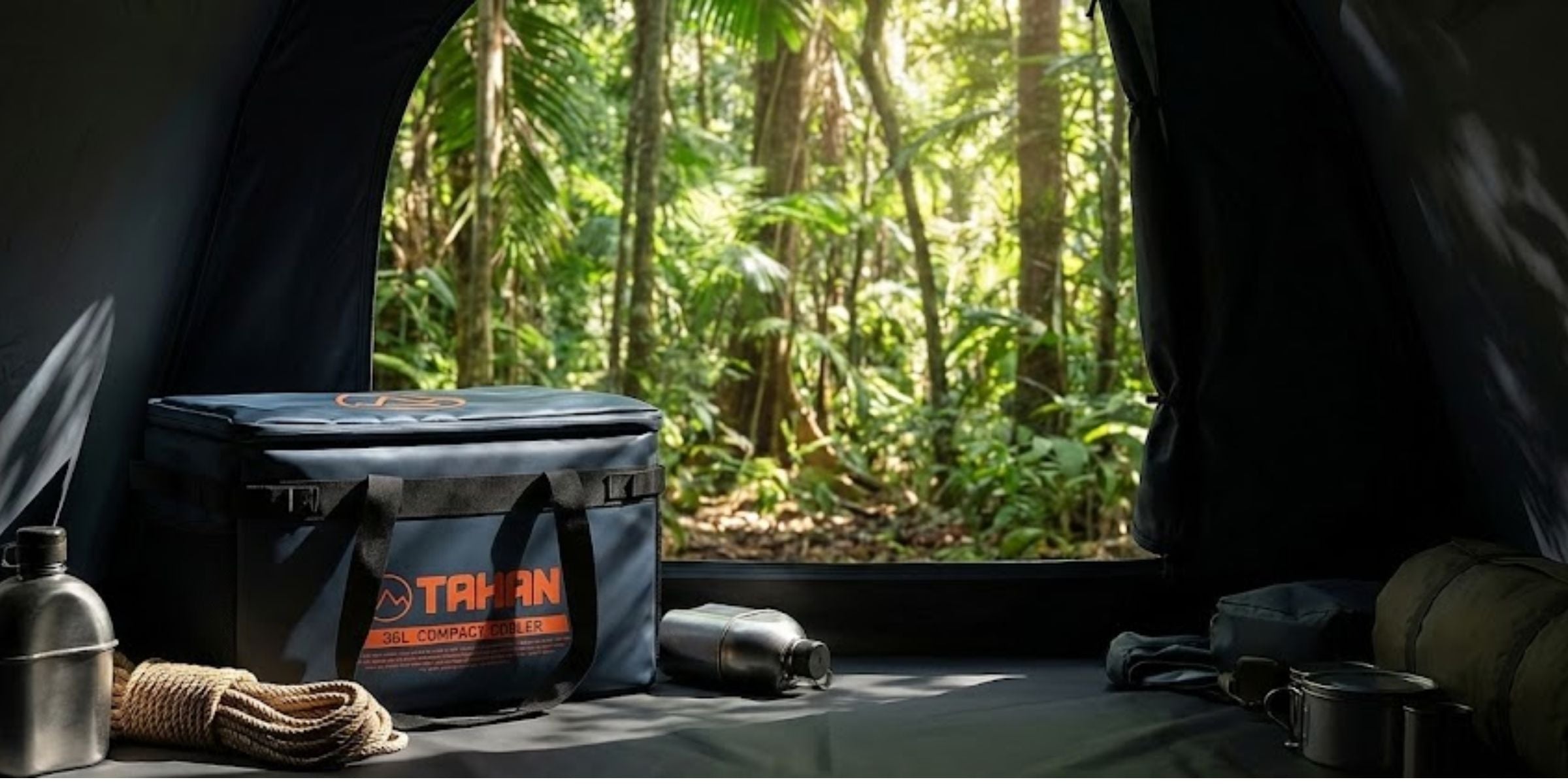


Humans have always sought shelter in tents since way back in 40,000 B.C. (yeah, they're that old) and as they evolved and innovations made massive leaps through the centuries, tents now come in many different shapes and sizes.
They're all built for different uses, so here's a look at the most popular tent types out there, what they look like, and what they're actually good for.
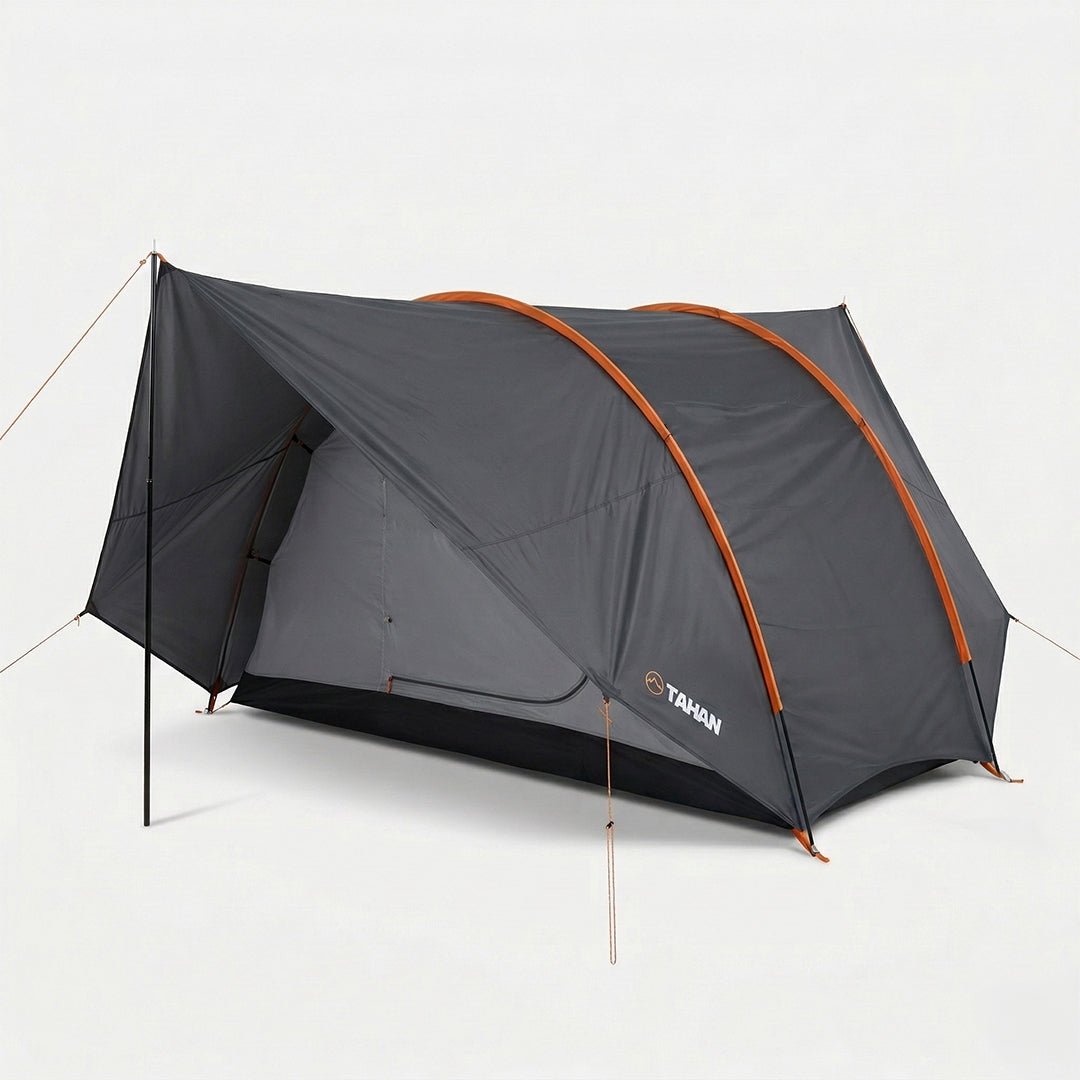
1. Ridge / A-frame Tents – For the Solo Campers
Ridge tents are basically every kid's drawing of a tent. As a successful artist myself, here's my drawing of a ridge tent:
Okay, for real. The name speaks for itself — a cross pole called a ridge stretches across the length of the tent and holds up the roof. While this simple design is surprisingly stable, ridge tents are heavy and bulky when packed, and they lack headspace, which makes them less than ideal for family trips.
That said, they're solid options for solo travellers who aren't planning on spending much time inside the tent.
Pros:
- Stable structure
- Pretty easy to set up
- Good option for solo travellers
Cons:
- Less storage space
- Less headroom
- Heavy and bulky when packed
2. Dome Tents – The Most Common Tent You'll Find
Probably the most popular tent type on the market. Dome tents come with 2 poles crossing over each other, with their ends going into the tent's floor to form a square base.
What's great about this design is that it stays up without needing stakes or guylines, and it offers decent headspace. Capacity can range from a single person all the way up to 8 people, and they're generally lightweight too.
The downside? Their lighter build makes them more susceptible to wind, and they tend to get less stable as they scale up in size.
Pros:
- Good headspace
- Can go up to 8-person capacity
- Lightweight and easy to carry
- Many models are freestanding
Cons:
- Gets less stable as they scale up in size
- More likely to be blown around in strong winds
- Catches wind more easily
3. Pop-up / Instant Tents – Hassle-Free, Super Quick Setup
Just like your favourite instant noodles, pop-up tents are all about saving time. They come in a couple of configurations — the umbrella-style (where a central hub pops the tent open like an umbrella) and the spring-coil style (where you literally throw the thing into the air and watch it explode into a tent).
While older models weren't great in strong weather, many improvements over the years have made pop-up tents more reliable in harsher conditions — to an extent. They're great for beachside camping, festivals, and backyard overnights, but don't bring one up a mountain.
If you're going the pop-up route and want to sleep well regardless of the tent type, a solid sleep setup matters just as much. Pair your tent with something like the TAHAN Panthera Inflatable Sleeping Pad (RM159) — compact, comfy, and works with pretty much any tent.

Pros:
- Near-instant setup
- Lightweight and portable
- Decent weatherproofing for casual use
- Freestanding
- Ideal for beach, backyard and festival camping
Cons:
- Prone to condensation
- May lack space depending on the model
- Not suitable for serious mountain conditions
4. Geodesic or Semi-Geodesic Tents – More Stable Than Your Income
Geodesic tents are easy to spot — they've got that golf ball look going on, and honestly they look more like actual domes than dome tents do. Am I right or am I tripping?
And here's a semi-geodesic for comparison:
Think of these as dome tents on steroids. Multiple criss-crossing poles create triangles and hexagons (straight out of Form 4 Maths) that distribute stress evenly across the structure — giving them an incredibly stable frame capable of withstanding seriously strong winds.
And just like Maths, pitching one is complicated. Options are also limited and they tend to be pricey. But hey, you get a giant golf ball shelter that can handle a storm.
Semi-geodesic tents are slightly easier to pitch but a bit less weather-resistant than their full geodesic cousins.
Pros:
- Extremely sturdy
- Can withstand really nasty weather
- Freestanding
Cons:
- Complicated to pitch
- Pricey
- Limited options on the market
5. Tunnel Tents – The "Light at the End of the Tunnel" Simulator
Tunnel tents have a caterpillar-like design made up of 2 or more curved poles that give a consistent overhead height throughout — so lots of headroom and plenty of living space.
Close all the windows, leave one end open, and you've got yourself a literal light at the end of the tunnel. Philosophical camping.
The roomy design allows for multiple sleeping compartments fitting up to 6 people, which makes them a popular pick for family trips. The catch? The separated poles mean tunnel tents are prone to sagging in the middle, and they collect water there if not pitched with enough tension. They also need to be guyed out properly — not freestanding.
Pros:
- Lightweight relative to size
- Very stable when pitched correctly
- Spacious interior
- Large vestibule area
- Lots of headroom
Cons:
- Prone to sagging and pooling water in the middle
- Not great against strong crosswinds
- Tricky to pitch solo
- Not freestanding
6. Inflatable Tents – Don't Worry, They Don't Explode
Pretty self-explanatory. Instead of poles, these tents are supported by air beams. You'll need an air pump — or someone with extraordinary lung capacity and nothing better to do.
They're genuinely easy to set up once you have the pump, but because the air beams are all connected as part of the tent body, you can't separate them — so you're moving the whole thing in one go. And that thing is heavy.

Speaking of pumps — if you're going inflatable, the TAHAN 3-in-1 VacBlower (RM189) is a handy bit of kit. It inflates, deflates, and doubles as a vacuum for packing up sleeping pads and mattresses. Saves a lot of lung power.
Pros:
- Easy to set up with a pump
- No poles to lose or snap
- Freestanding
Cons:
- Heavy and awkward to transport
- Requires a pump
- Weatherproofing varies a lot by model
So Which Tent Type is Right for You?
Quick answer: it depends on where you're camping and how many people are coming. Solo backpacker? A ridge or dome tent does the job. Family trip? Look at tunnel tents or a proper family dome. Hardcore alpine conditions? Geodesic all the way. Just chilling at a beachside campsite? A pop-up tent is more than enough.
If you're still figuring out your full camp setup beyond just the tent, check out our Beginner Camping Checklist — it covers everything from shelter to sleeping gear so you don't show up underprepared.
Happy camping!